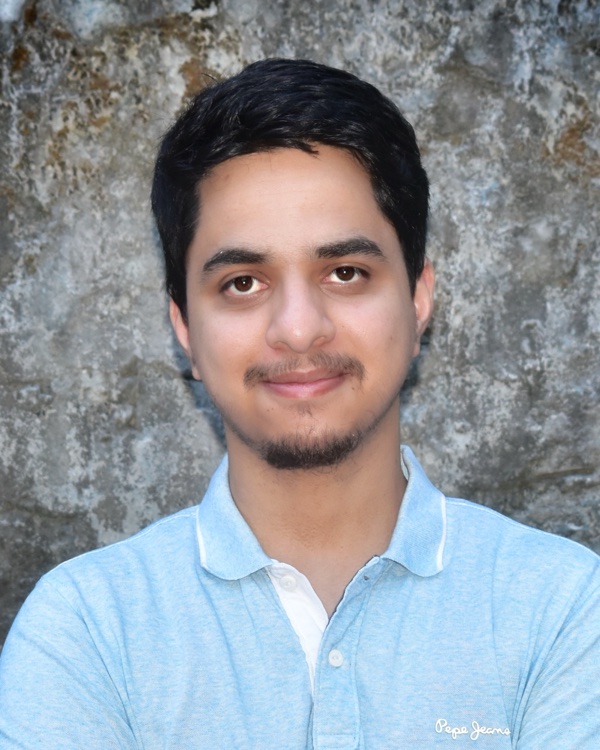
Portrait of Akshay Thakur

</> Akshay Thakur

PhD Candidate // Aerospace & Mechanical Engineering // University of Notre Dame

about 00

I'm a PhD candidate in the Department of Aerospace and Mechanical Engineering at the University of Notre Dame, advised by Prof. Matthew J. Zahr in the CAMO Lab. My research sits at the intersection of scientific machine learning, finite element / finite volume methods, and model order reduction. I build numerical methods that combine classical scientific computing with deep learning to solve PDEs more efficiently and reliably.

Right now I'm working on feature-tracking physics-informed neural networks for boundary layers and shocks, and on optimization-based nonlinear discontinuous Galerkin methods that resolve thin layers on coarse meshes. I also contribute to an in-house finite element package written in Julia. I've interned at Synopsys, building foundation models for external aerodynamics, and at Mitsubishi Electric Research Labs, building neural-operator and GNN surrogates for sound propagation. Before Notre Dame, I worked at the CSCCM Lab at IIT Delhi on neural operators and generative surrogates for stochastic PDEs.

Reach me at athakur3@nd.edu. You can also find me on Google Scholar, GitHub, and LinkedIn.

scientific ML physics-informed neural networks neural operators discontinuous Galerkin finite volume methods uncertainty quantification model order reduction hyperbolic PDEs

recent 01

experience 02

education

research projects 03

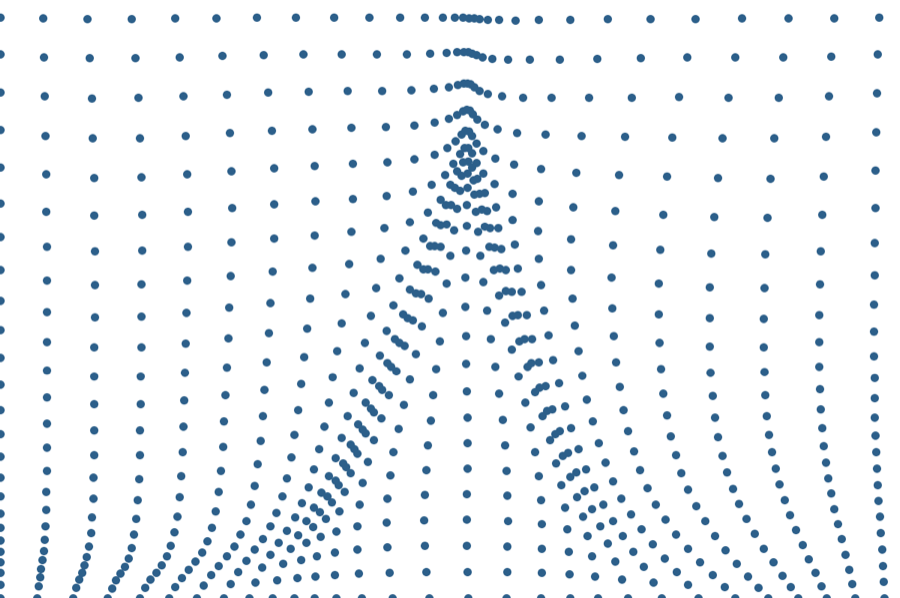
Collocation points clustered along merging shocks by a learned coordinate map
CAMO Lab · 2024 – present
FT-PINN: feature tracking in physics-informed neural networks
PINNs struggle with localized features such as thin boundary layers and shocks: the loss is dominated by the smooth bulk, so steep gradients are under-resolved. FT-PINN puts the network on a fixed reference domain and composes it with a trainable coordinate map, optimized jointly with the network weights. Collocation points then concentrate where the solution is steep, with no resampling and no prior knowledge of where the feature is.
  • Part I: analytical tensor-product manifolds for boundary layers (advection–diffusion at Pe = 10³, flat plate at Re = 10⁶).
  • Part II: RBF deformation manifolds for shocks (Burgers merging and decelerating shocks, Sod shock tube, Euler regular reflection).
CAMO Lab · ongoing
Optimization-based nonlinear discontinuous Galerkin (NLDG) for high-Péclet flows
The usual way to resolve thin viscous layers is with highly stretched, anisotropic meshes, which are tedious and fragile to generate. NLDG takes the opposite approach. It keeps coarse, isotropic meshes and enriches the DG approximation space with a nonlinear manifold of trial functions. The nonlinear parameters and the solution coefficients are solved for together through residual minimization, so no a priori knowledge of the layer scale is needed.
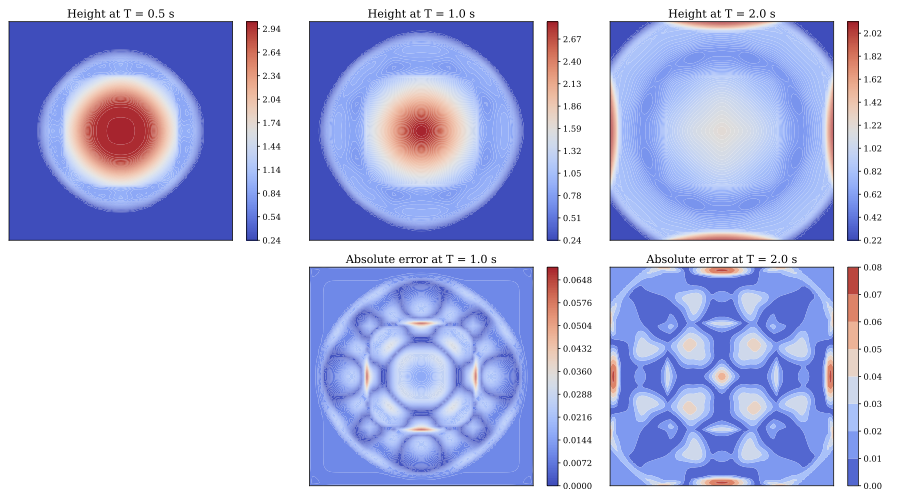
Shallow water height field and error using the bi-fidelity neural flux
CAMO Lab · 2023 – 2025
Neural Godunov corrections for approximate Riemann solvers
In finite volume schemes, the exact Godunov flux is accurate but expensive, while approximate Riemann solvers such as Roe are cheap but diffusive near shocks. A bi-fidelity neural network learns the residual between the Godunov and Roe fluxes, which gives a cheap correction with near-Godunov accuracy. It was tested a posteriori inside an unstructured PyTorch FV solver on Burgers' equation and the 2-D shallow water equations.
Predicted mean, standard deviation and error over h-adaptive iterations
Notre Dame × IIT Delhi · 2024 – 2025
Scalable h-adaptive probabilistic PDE solver
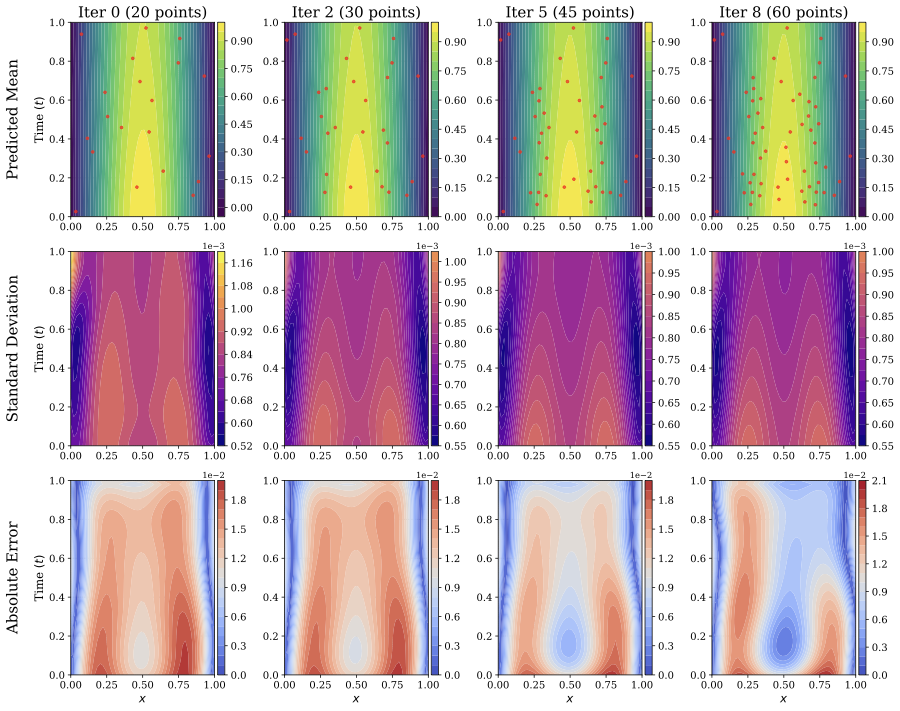
A Gaussian-process-based probabilistic solver that conditions a GP prior on the PDE and boundary conditions, so it quantifies epistemic discretization uncertainty. Solving for the posterior normally costs O(N³); stochastic dual descent (a dual reformulation with randomized coordinate gradients and Nesterov momentum) avoids that. A clustering-based active-learning loop adds collocation points where the posterior variance is highest. The method handles both time-independent and time-dependent systems.
Multi-fidelity wavelet neural operator architecture
CSCCM Lab, IIT Delhi · 2021 – 2024
Multi-fidelity wavelet neural operators for reliability analysis
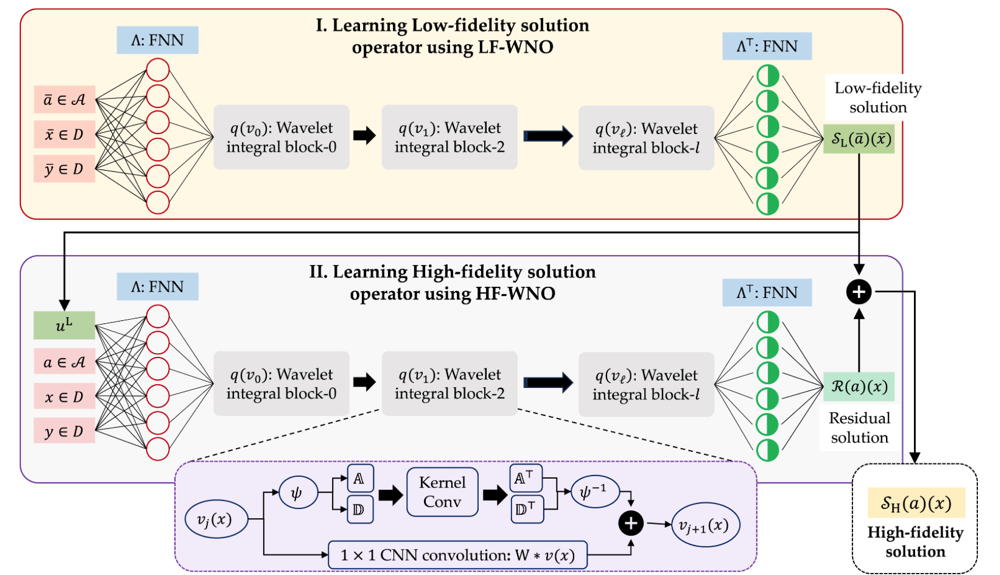
A low-fidelity WNO learns the coarse solution operator, and a high-fidelity WNO learns the residual correction from a small set of expensive simulations. The resulting surrogate is used for time-independent and time-dependent reliability analysis, including failure probability and first-passage time, on Darcy flow in a notched triangular domain and on the unsteady Allen–Cahn equation.
Randomized prior Fourier neural operator architecture
COMSAIL Lab · 2022 – 2023
Randomized-prior Fourier neural operators for uncertainty-aware rollout
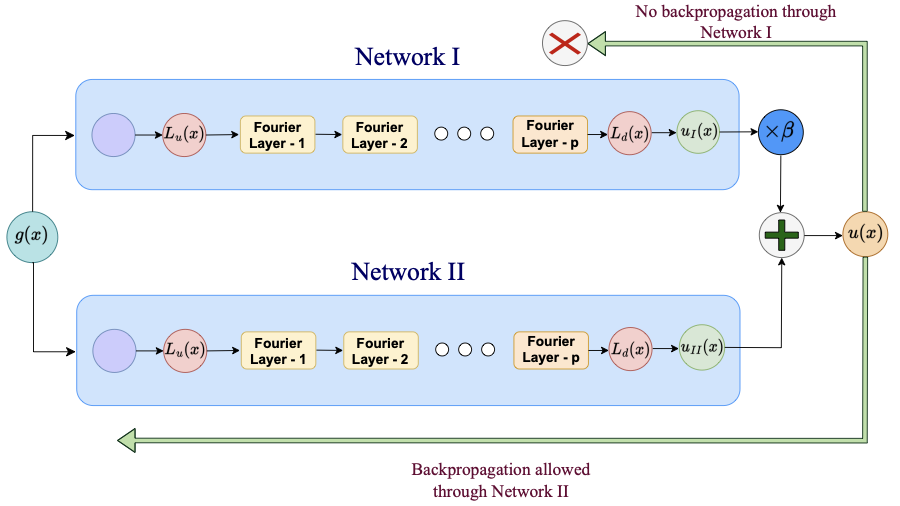
Deep ensembles tend to give overconfident uncertainty estimates. This project extends randomized prior networks to the Fourier neural operator: each ensemble member pairs a trainable FNO with a fixed, randomly initialized prior FNO. The result is efficient, parallelizable UQ for spatiotemporal rollouts of time-dependent PDEs such as the 2-D Allen–Cahn equation.

publications 04

teaching 05

University of Notre Dame